Hermiq skills tutorial series — Part 2: Qualifying a skill (L1–L7)
Run the Qualify action on the seeded skills, read the seven-level scorecard, fix a failing level, and attest L4 as a curator. Also covers why most skills stop at L4, and why that is fine. Part 2 of 4.

Every skill row in the Hermiq catalog carries a badge of seven dots. In this part you learn what the dots mean, run the Qualify action to earn them mechanically, read the scorecard that explains every failure, and attest level 4 as a human curator. You also learn why the ladder deliberately gets harder to climb from level 5 on.
The ladder, briefly
The maturity model comes from the fleet-wide skill-writing practice (ADR-068) and has seven levels. Each level stacks on the previous one: level n only counts when levels 1 through n minus 1 also pass.
| Level | Name | What it proves |
|---|---|---|
| L1 | Anatomy | The skill parses: frontmatter with name and description, non-empty body |
| L2 | Golden rule | The description triggers well, the body stays compact and disclosed progressively |
| L3 | Foundations | Detail lives in references/ or examples/ files, not in one monolith |
| L4 | Personalisation | A human attests the skill carries real business knowledge |
| L5 | Measurement | Paired eval evidence: pass rate, baseline delta, last validated |
| L6 | Self-improvement | A living learnings loop with consolidation |
| L7 | Workforce | The skill demonstrably runs inside an executed orchestration chain |
Three things to know before you touch anything:
- L1 to L3 are mechanical. Hermiq computes them from the skill's content. No judgement involved.
- L4 is human, always. No heuristic can verify that a skill encodes your organisation's actual way of working. A curator attests it, on the record.
- L5 to L7 are evidence-based. Hermiq never grants them from the skill's text. The evidence is written by other subsystems: paired eval runs (Part 3), the learnings loop (Part 4), and executed orchestration chains. No evidence, no level, with the reason spelled out on the scorecard.
Maturity is also strictly separate from the lifecycle state you saw in Part 1. A quarantined skill keeps its maturity; qualifying never changes state. And none of the maturity fields ever enter the exported agentskills.io package, which stays byte-identical before and after qualification.
Step 1: Read the dots on the catalog
Open Skills. The three example seeds ship at a deliberate spread:
| Skill | Dots | Why |
|---|---|---|
meeting-notes-cleanup | 1 | Valid structure, but the description is a bare noun phrase |
woo-request-triage | 2 | Good trigger description, compact body, no reference files |
tender-summary | 4 | References, examples, and a seeded curator attestation |
Verify: the badges on the three rows show 1, 2, and 4 filled dots, each with a textual level for screen readers.
Step 2: Qualify a skill and read the scorecard
Qualification recomputes L1 to L3 from the current content, persists the result, and returns a scorecard for all seven levels.
- On the
meeting-notes-cleanuprow, open the row actions and choose Qualify. - The scorecard opens: seven rows, each with pass or fail and readable reasons.
Expect this picture:
- L1 pass. Frontmatter parses, name and description present, body non-empty.
- L2 fail, with a triggering reason. The description
Meeting notes helpernames a topic but not a trigger. It does not start with a verb, and it never says when an agent should use it. - Everything above L2 fails by the contiguity rule, whatever else the skill has.
The L2 check tests three things at once: trigger quality of the description (a
verb-shaped phrase plus when-to-use phrasing), a body under 500 lines, and progressive
disclosure (a large body must be accompanied by references/ files rather than being
one monolith).
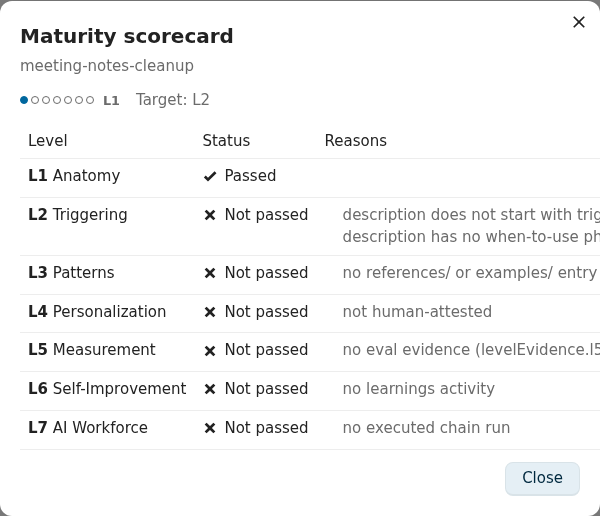
meeting-notes-cleanup: L1 passes, L2 fails on trigger quality, and everything above fails by contiguity. Each failing row names its reason.Verify: the scorecard shows L1 passed and L2 failed with a reason that mentions the description's trigger quality.
Step 3: Fix the failing level and re-qualify
The scorecard tells you what to fix first. For meeting-notes-cleanup that is the
description.
- Edit
meeting-notes-cleanup(the authoring form from Part 1). - Replace the description with a trigger-quality one:
Clean up raw meeting notes — use when the user pastes meeting notes and wants tidy headings, grouped action items, and decisions kept verbatim. - Update the frontmatter's
description:line to match, and save. - Run Qualify again.
Verify: the skill now reports level 2, and the scorecard's first failure has moved to L3 with a missing references/examples reason.
To reach L3 you would add at least one references/* or examples/* entry in the
files editor. Try it on your own pet-store-order-summary skill from Part 1: add
examples/order-summary-example.md with one worked example and re-qualify. L3 now
passes.
Step 4: Attest L4 as a curator
L4 says: this skill encodes business-specific knowledge, and a person checked. Hermiq
refuses to guess this. The attest action is gated by action authorization: your group
must be mapped to the skill.attest-maturity action in Hermiq's admin settings.
- As an admin, confirm your group is mapped to
skill.attest-maturity(Hermiq admin settings, action authorization section). Admins pass by default. - Open the
woo-request-triagedetail page. After step 3-style fixes it sits at the level its content earns. - Use the Attest L4 action on the maturity scorecard and add a short note, for
example:
Checked routing and deadlines against our municipality's WOO process documentation. - The attestation records who attested, when, and the note, then recomputes the level.
An unauthorized user gets a plain 403 and the skill stays unchanged. And attesting a skill that still fails L2 or L3 does not skip anything: levels stay contiguous, so the attestation waits in the evidence until the lower levels pass.
Verify: the detail scorecard shows the attestation with your user id and timestamp under L4.
Step 5: Read why the ladder stops here for now
Open tender-summary. It ships at L4 with targetLevel: 5, so the scorecard shows
exactly the situation most real skills live in:
- L1 to L3 pass mechanically.
- L4 carries a seeded attestation.
- L5 fails with an eval-evidence reason. No paired eval run has written evidence for this skill yet.
You cannot fix this from the skill page. L5 evidence has exactly one writer: a
completed paired eval run. Hand-editing maturityLevel does not work either; the
write paths silently ignore client-supplied maturity fields and carry the stored
values forward. Part 3 sets up and runs that eval.
Verify: the tender-summary scorecard reports L5 failed with a reason pointing
at missing eval evidence.
Why most skills plateau at L4
Most skills stop at L4, and that is a reasonable place to stop. L5 costs eval datasets and roughly double the tokens per run. L6 costs a capture and consolidation loop. L7 costs an orchestrated chain that actually executes. For a skill you use weekly, L4 with a fresh attestation is enough. Reserve L5 and beyond for the skills that carry daily workflows or steer other skills. For those, measured evidence is worth the extra cost.
Test yourself
Question 1: A skill has excellent references/ files but a description that is a
bare noun phrase. What level does Qualify report, and why?
Hint
Think about the contiguity rule.
Answer
Level 1. The references would satisfy L3's check, but L2 fails on trigger quality, and a passed higher check never skips a failed lower level. The scorecard reports L2 failed with a triggering reason and L3's own check as passing, so you know exactly what to fix.
Question 2: Why can an admin edit a skill's targetLevel but not its
maturityLevel?
Hint
One field records intent; the other records a computed fact.
Answer
targetLevel is curator intent: where you want the skill to go. It is
freely editable. maturityLevel is a computed fact with exactly one
writer per evidence type: the qualify service for L1–L3, the attest endpoint for L4,
and external subsystems for L5–L7. Client-supplied values are silently ignored so
the badge always tells the truth.
Where to go from here
Your skills now have accurate badges and one named gap: eval evidence. Part 3 links an eval dataset to a skill, runs a paired with-and-without baseline, and watches the L5 evidence arrive on the scorecard.
Volgende stappen
Link a dataset, run with/without baselines, read pass rate and baseline delta, and understand the cost of joint versus per-skill mode.
The same L4-to-L5 step in the Claude Code world, with evals.json and the skill-creator eval runner.